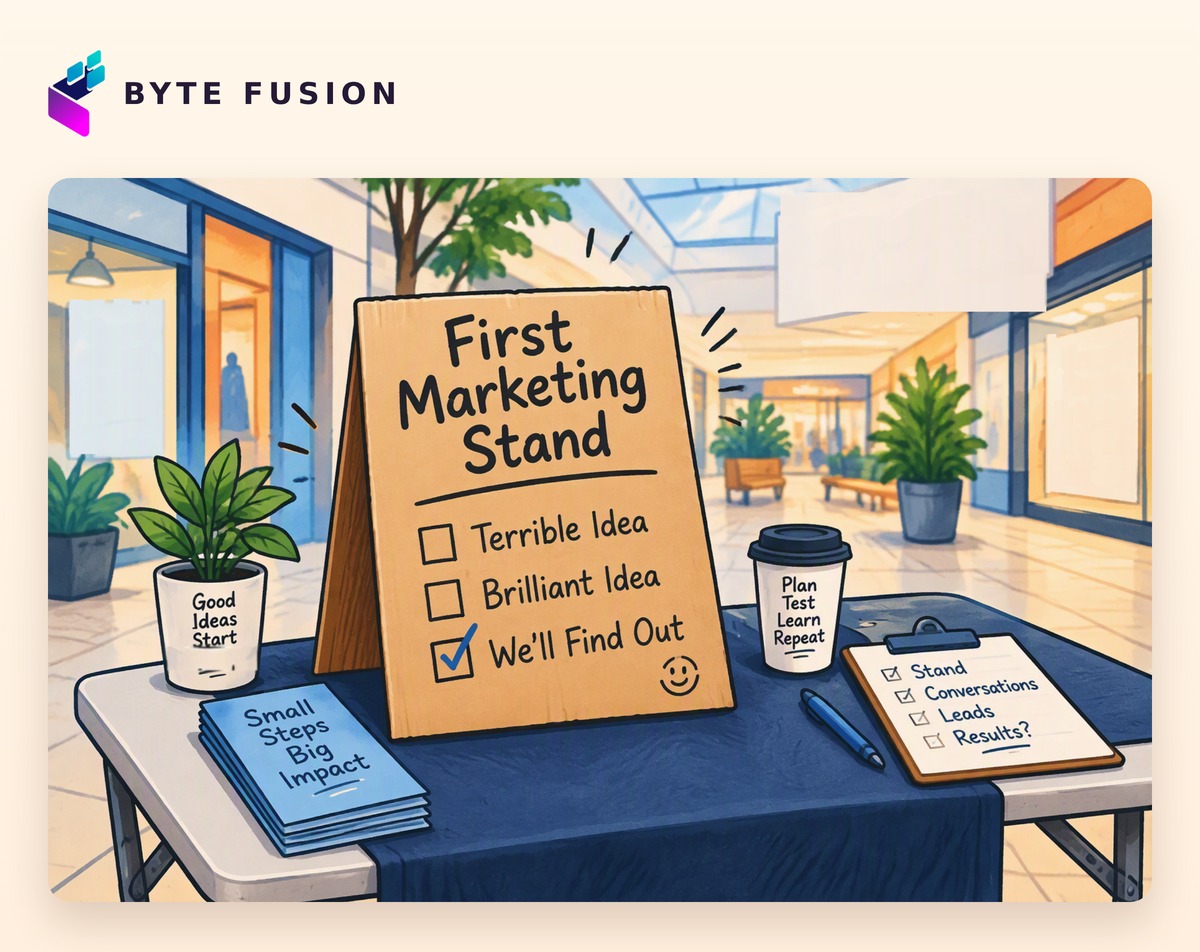
Most businesses that take a stand at a shopping centre have no idea afterwards whether it was worth the money. They know it felt busy. They know they spoke to people. Somebody says it was good for brand awareness, the table goes back in the storeroom, and that is the end of it.
We are doing our first stand on Saturday, at Checkers Court in Village Mall. Rather than find out in six months that we cannot answer the question, we decided to build the answer in from the start.
Here is what we did, including the part we got wrong.
A QR code cannot be scanned inside a phone
Our first set of adverts carried QR codes. It took an embarrassingly long time to notice the obvious problem: the advert appears on a phone, and you cannot scan a code with the same phone you are looking at it on.
So, the adverts became click-to-WhatsApp instead. Tapping one opens WhatsApp with a message already typed, ready to send. One tap, no typing, no app switching.
Every advert has its own word
That pre-typed message is where the useful part hides. Each advert opens WhatsApp with a different reference word at the start of the message.
When an enquiry arrives, the first word tells us which advert produced it. Not which campaign, which advert. That is the difference between knowing that advertising works and knowing that the one about old laptops works and the one about backups does not.
It costs nothing to set up, and it is the single most useful thing in this whole exercise.
We nearly advertised a Hartbeespoort stand to Johannesburg
This is the part worth reading if you ever buy advertising yourself.
We set the audience by typing in the area name, the way you would expect to. The tool accepted it and reported an audience of 12.7 million people. For a stand at a shopping centre in Hartbeespoort.
The name had resolved to the entire municipality, which stretches far enough to take in Johannesburg and Pretoria. Had we left it, most of the budget would have been spent showing a Saturday morning advert to people an hour and a half away who were never going to attend.
The fix was to drop a pin on the shopping centre itself and set a ten-mile radius. The audience went from 12.7 million to roughly 273,000. Same budget, aimed at people who could walk in.
If you take one thing from this post: check what your advertising tool thinks your area means, in people, before you spend anything. The default is almost never what you pictured.
What is actually on the table
No gimmicks and no competition. A screen running a short loop, a table, and two things to do.
- A two-minute check. Five plain questions about how your business handles its IT. You answer them, you get a score, and we send you a short-written report afterwards explaining what your answers mean. No jargon, no sales pitch in it.
- Bring an old laptop. If you have one gathering dust, bring it and we will tell you honestly whether it is worth keeping. Some of them are.
If you fill in a card we take your name, business, phone and email. Nothing else. No identity numbers, no addresses, and the consent line only get ticked if you say yes out loud. Every card is a report we owe you by Monday.
What we will measure
These are written down before the day, which is the only way the exercise means anything.
- How many people reached, and what that cost per thousand. As this goes out, the campaign has reached 14,602 people at R6.46 per thousand.
- How many conversations the adverts started, and what each one cost.
- How many enquiries arrived against each reference word.
- How many people stopped at the table, and how many filled in a card.
- How many reports we sent, and how many got a reply.
- And the only one that really counts: how many of those became customers.
We will publish the numbers
Including the ones that make us look silly. We already know the audience mistake goes in, because it nearly cost us the whole budget and somebody reading this is about to make the same one.
A stand is not a brand awareness exercise unless you decide in advance that you cannot measure it. We decided we could.
Come and find out on Saturday whether we were right.